Long before humans appeared, evolution was already testing solutions to problems that would shape the mammals and, eventually, the species we became.
The story of human evolution is often told backwards. We know where it eventually led, so it can be tempting to imagine a straightforward progression from primitive animals to increasingly sophisticated forms of life.
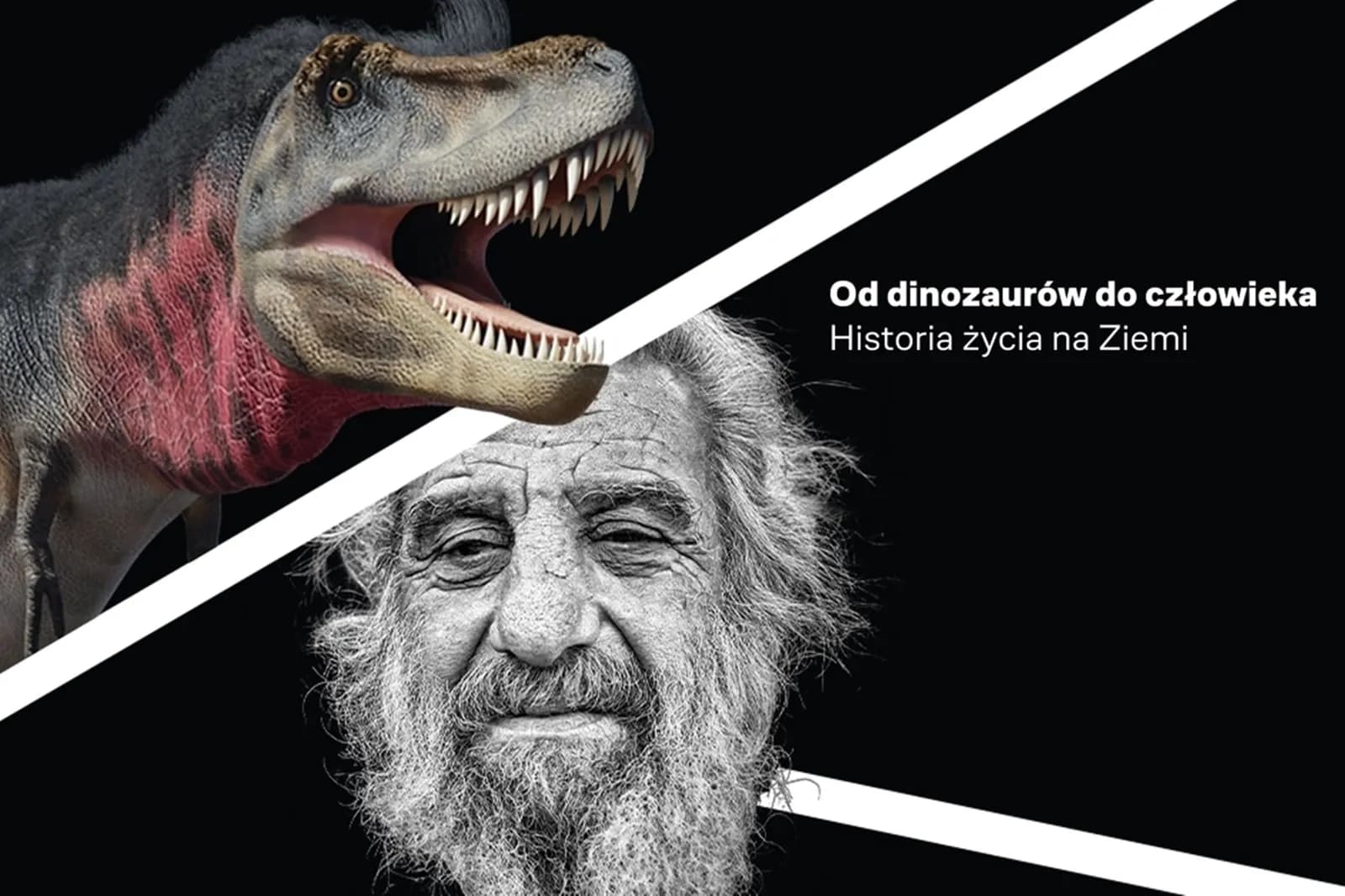
The exhibition From Dinosaurs to Humans: The History of Life on Earth at the Upper Silesian Museum in Bytom takes a different approach. Rather than presenting evolution simply as a procession of species arranged in chronological order, it asks what problems animals had to solve along the way.
The exhibition follows the evolution of mammals against changing natural environments from the Carboniferous to the Quaternary. Its starting point is consequently much earlier than the appearance of recognisable mammals, tracing the lineage through synapsids that still differed relatively little from reptiles.
This is what gives the exhibition its particular structure. The story is not simply about what came next. It is about why particular characteristics emerged and what environmental pressures and competition made them useful.
Evolution was not following a plan
Among the questions explored in the exhibition are warm-bloodedness, the development of the mammalian ear, the emergence of fur and changes in the brain.
These may seem like familiar features of mammals today, but considered from an evolutionary perspective they represent significant developments. The exhibition looks at how changing conditions and the challenges faced by early mammals contributed to these transformations. It also examines the importance of the miniaturisation of Mesozoic mammals in the development of the ear.
This approach changes the visitor's perspective. Instead of asking which animal appeared first, the exhibition encourages questions about survival and adaptation.
What advantages did a particular feature provide? What environmental conditions made it possible? How did early mammals compete with other animals? And how many different evolutionary solutions existed before the characteristics familiar to us emerged?
The answers are presented through a mixture of original fossils and reconstructions, making the scientific narrative tangible.
Fossils provide the evidence, reconstructions restore the scale
Among the original remains are fossils of the Wawel Dragon, Cyclotosaurus, mammoth and cave bear. Alongside them are reconstructions of animals including Lystrosaurus and Metoposaurus, as well as reconstructions of Lisowicia skulls and early mammals such as Morganucodonta and Spinolestes.
The collection also reaches into more recent stages of the story, with reconstructions of a sabre-toothed tiger, short-faced bear and a series of hominid skulls.
For visitors, this combination is important. Fossils provide direct physical evidence of organisms that lived in the distant past, while reconstructions help communicate what those animals may have looked like and how the evidence can be interpreted.
The exhibition also has a distinctly local scientific dimension. Lisowicia is particularly relevant to the wider story of Polish palaeontology. The animal was a large dicynodont from the Late Triassic, and its discovery in Poland helped broaden scientific understanding of how large some herbivorous synapsids could become. Rather than treating prehistoric life as something that happened only in distant parts of the world, such examples connect the subject with research and discoveries from this part of Europe.
The final step is not really a final step
The exhibition eventually reaches humans, including a reconstruction of an early human camp. Yet this is not presented as the inevitable destination of millions of years of evolution.
That distinction is central to the exhibition's argument. Evolution does not work towards a predetermined endpoint. The characteristics that appear obvious to us today were shaped by particular environmental conditions, biological constraints and competition over immense periods of time.
The museum's educational programme extends this approach beyond the display itself. The exhibition is accompanied by educational activities, while the museum has also produced the publication Podróż przez wieki. Bakterie – dinozaury – ludzie and additional material through its Skąd się bierze zwierzę blog.
The exhibition has already become the setting for curator-led tours examining subjects ranging from the evolution of mammals to the challenges faced by humans during the Ice Age.
For Bytom, this makes the exhibition more than a display of prehistoric specimens. It is an opportunity to encounter evolutionary science through objects, reconstructed animals and questions that remain surprisingly relevant.
After all, the most interesting part of the journey from dinosaurs to humans may not be the destination. It is the extraordinary number of problems life had to solve before we arrived.
Visitor Information
Exhibition: From Dinosaurs to Humans: The History of Life on Earth
Venue: Upper Silesian Museum in Bytom, ul. Wojciecha Korfantego 34, Bytom
Dates: 19 September 2025 – 31 December 2026
Curators: Marek Ryś, Dorota Podyma and Dr Roland Dobosz
Regular ticket: PLN 10
Reduced ticket for adults/schoolchildren: PLN 5